At our home in Detroit, Michigan, at 7:45 PM last night, there was a mad scramble to get the computers down and the lights off and locate candles, oil lamps and matches. I was afraid we wouldn't make it, but we did! YAY! We could see three other houses from our front windows that were dark, so we decided to walk around the block and count dark and light houses. On our immediate block, there were 111 electrically lit houses and only 17 that were dark, and some of those were abandoned (empty, for sale) and I am sure on a Saturday night, some people were just out partying. There was a row of six houses all dark on the next block over, but we had agreed only to count our block. BB thinks maybe 5% of the people complied. He thinks most people didn't even know about it. I was really disappointed.
PB complained bitterly the whole time and kept wanting to turn the light on and if I used the indiglo on my watch to let him know how long he had to wait, he called me a hypocrite. He refused to do anything but sit there and complain for a full hour. BB told PB we were "doing it for Mama." Not for the earth or the environment, but for me. In other words, they wouldn't have bothered if I hadn't insisted. Very sad. I am sad, hope your report is better.
Sunday, March 30, 2008


Saturday, March 29, 2008
EARTH HOUR TONIGHT!
REMEMBER! Turn off your lights tonight from 8-9, and all unessential power users. Computer. TV. Help save the earth and raise awareness.
Read what BerryBird has to say here and here. Visit the official site! AND TURN OFF YOUR LIGHTS! 8-9 PM.
Read what BerryBird has to say here and here. Visit the official site! AND TURN OFF YOUR LIGHTS! 8-9 PM.
Tuesday, March 11, 2008
Project Budburst

Wednesday, December 05, 2007
T is for Tree

Click image to view larger.
Click here to see T is for Toe (another kind of nature!)
Monday, December 03, 2007
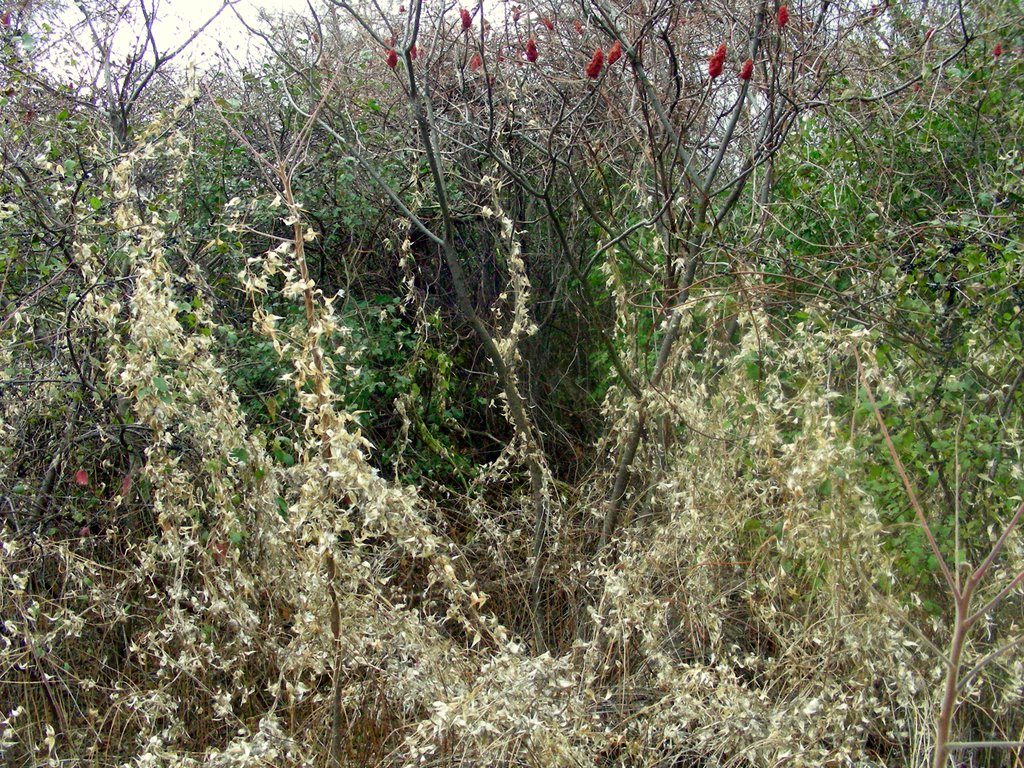
Dune Grasses in a War of Ignornance

Monday, November 19, 2007
S is for Squirrel

the alphabet and decided to do book for my grandchildren. Here is
one of its possible pages. Click image to view larger.
I like squirrels more than many people in part becasue I love animals
and in part because I used to be a rehabilitator and this is one of
the squirrels I raised.
Tuesday, November 13, 2007
Witch Hazel Flowers

lovely sight it is indeed when all the leaves are gone from the trees
and winter is coming to see all those bright sunny flowers. Yes, I
was planning to subsume this blog into another, but I don't have time
right now.
Thursday, October 25, 2007
Screech Owl
We were very excited last year to see a screech owl in our neighbor's tree. Last night, we saw one in our own tree--saw it fly to a hole, go inside, come out and fly away. It would be very exciting if it would nest there.
Wednesday, October 24, 2007
Red Maple

Sometimes it seems as if every single autumn leaf is a work of art. Of course, some are prettier than others. The three central leaves here are red maples, Acer rubrum. NOT the cultivar of Norway maple ("Crimson King etc") that many people call red maple, but real red maples. They are pioneer species, often hybridize with silver maples. Their sap can be boiled down for maple syrup, but it takes twice as much as with sugar maple. Red maples flower very early in the spring with tiny red flowers. They often grow in swamps and bogs and turn color very early--brilliant scarlet.

Thursday, August 09, 2007
Cricket Time
It's dark and warm and the crickets and singing their sweet summer cadence, rising and falling and jingling like summer jingle bells. I'm out walking. When I was walking earlier, the cicadas were singing, a loud raucous din. It was a diurnal sound to this softer nocturnal one. I wanted to stay outside and listen for the change from one to the other. One would think that since I'm 61 years old, I would have heard that transition, but if I have, I cannot recall it at the moment.
Do they overlap each other? Does one stop and the other begin?
I wanted to listen, but I did not. I had things to do inside, and in the air-conditioned house, the cricket and cicada sounds do not come in.
Do they overlap each other? Does one stop and the other begin?
I wanted to listen, but I did not. I had things to do inside, and in the air-conditioned house, the cricket and cicada sounds do not come in.
Saturday, March 03, 2007
Saturday, February 10, 2007
Robins!

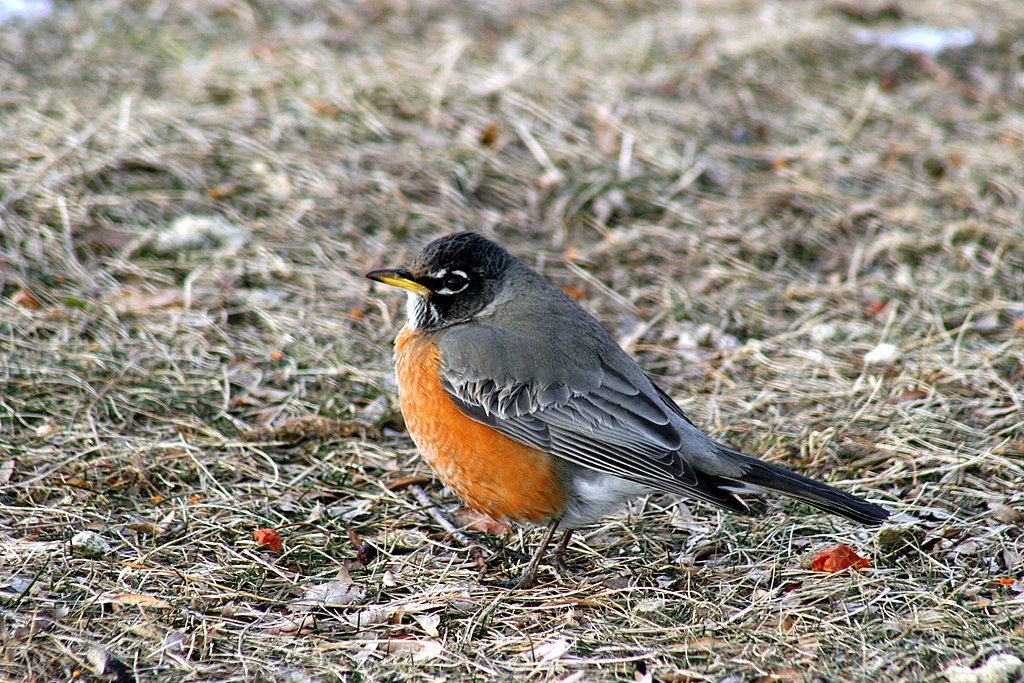
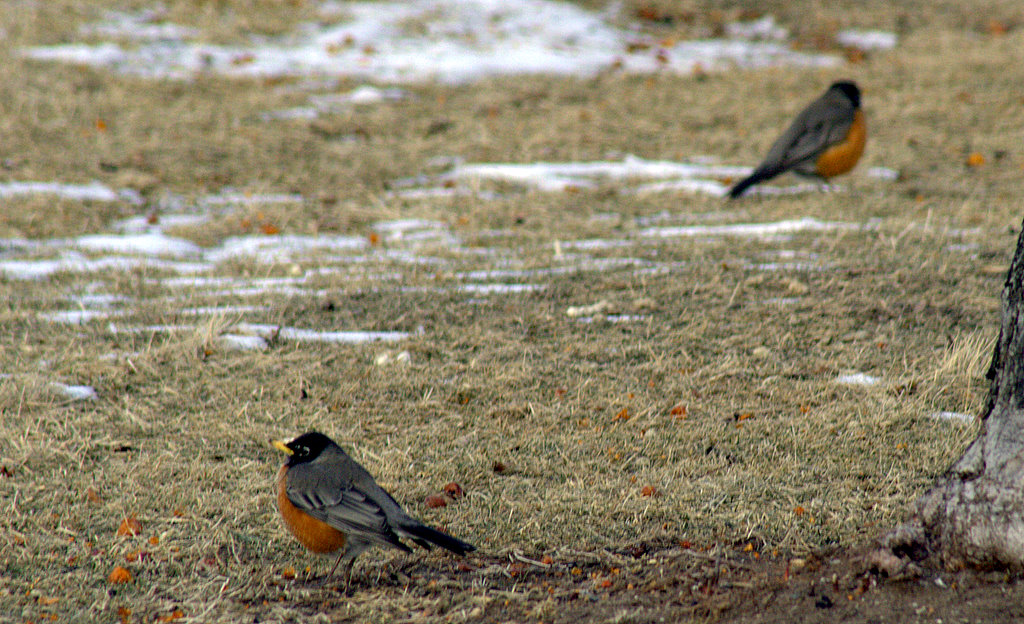 Robins don't al always migrate. Some spend the winter. But there are suddenly a lot in evidence that weren't obvious a short while ago. It's February, it's winter, it's cold! They are having to work hard for food and water.
They can't eat worms, so they are eating crab apples, and grabbing a drink from a hole in the ice. I don't want any harm to come to the poalr bears and penguins, the arctic foxes and ptarmigans, but I wouldn't mind a bit of warmth! Think worms for the robins?
Friday, January 05, 2007
Flower Photo Friday, unseasonal Flowers

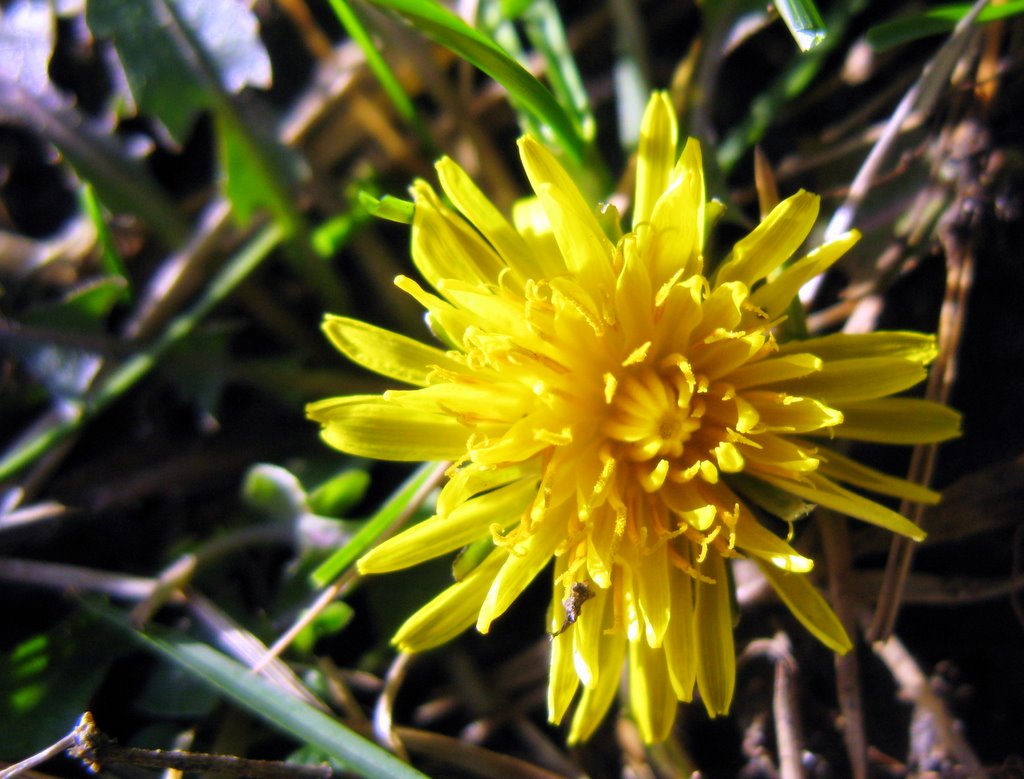
 In Detroit, where I now live, there is usually snow on the ground in January, everything is frozen, and there are no flowers in evidence. But this year, the temperatures so far have been unseasonably warm and we have flowers in blossom.
Pansies are perrenials and opportunists--they will flower whenever they can. Flowering Kale is cold hardy--but not usually in January. Dandelions are spring flowers--and either they are confused or we're having a very early spring.
see more.
Thursday, January 04, 2007
Sidewalk "Fossils:" Squirrel tracks
 It could almost be sand, but it's not. It's a sidewalk which contains the footprints of a squirrel. Front feet upper left, back feet lower right.
This is part of an ongoing series I am doing on sidewalk fossils, archeology, anthropology and art. I don't have a title for it, so let me know if you have any good ideas.
Wednesday, December 13, 2006
The Skull of a Canada Goose
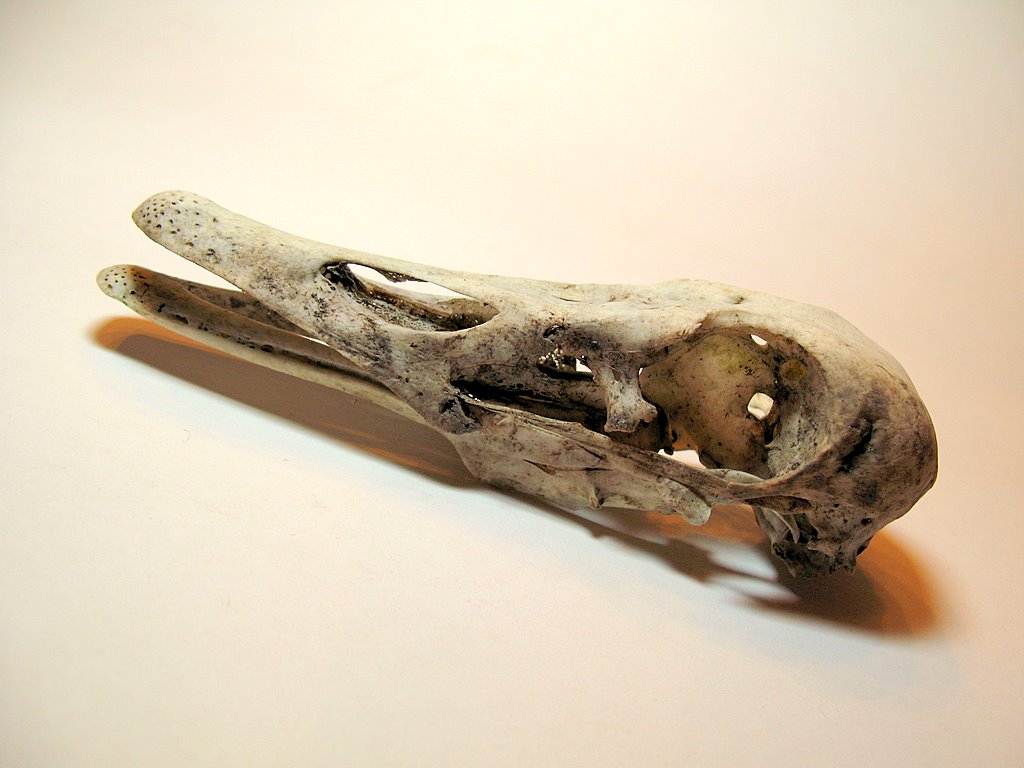 I found several of these in Hamilton, Ontario, Canada on a penninsula of land that jutted into a bay that was used for huge ships loading and unloading cargo. I am sorry the geese died. I'm not sure what was responsible for their demise, but I was happy to find the skulls. They have not been cleaned.
This picture was part of the "first light" series from my new camera, Giovanna. I was using the big flash from my big cameras on her.
Sunday, November 26, 2006
Turning to Dirt
 Along the dirt road that circles the Lake at Cranbrook, leaves were being crushed into the ground by passing construction vehicles. The almost seemed to disappear--but not quite.
Sunday, November 05, 2006
Tuesday, October 17, 2006
"What's That?"
Keith and I were walking along Moran on our way home from our nightly constitutional when we heard a strange quavering call. "What's that?" I asked. We stopped to listen. "A cat?" Keith asked? "It doesn't sound like a cat to me," I answered, "it sounds like a screech owl. Maybe it's a Halloween recording." Keith stopped and looked up into the closest tree--there was a lump up there. I got my binoculars out of my pocket and sure enough, it was a little screech owl. After we'd watched it a while, I decided to attempt a photo, but it flew just as I got the camera ready. We were pleased. We hadn't expected to have a nature encounter two doors down from our house in the city on a dark rainy night.
Saturday, July 15, 2006
Snapping Turtle
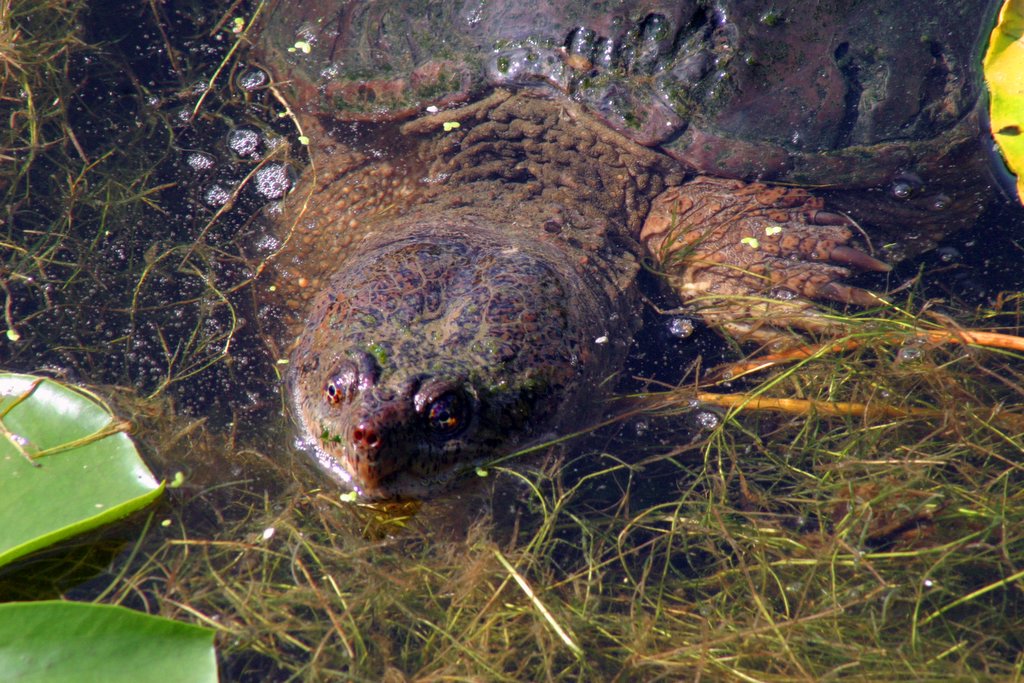 Snapping Turtle, by Mary Stebbins, click image to view larger.
Rogers Environmental Education Center, Sherberne
Snapping turtles eat fish, ducklings, and dead animals. They have very powerful jaws. Algae grows on ther shells.
Subscribe to:
Posts (Atom)